How to Use a Monthly SIP Calculator to Plan Your Financial Goals in 2026
Why Most People Start Investing All Wrong
Let’s be honest. Most of us have, at some point, decided to “start investing” with the same energy we bring to a New Year’s resolution. Strong conviction on January 1st. By March, forgotten. The problem isn’t motivation, really. It’s that we never sit down and actually do the math. We invest money in a vaguely defined “future-oriented” manner, hoping for positive outcomes. Sound familiar?
Now, here’s the thing. 2026 is a genuinely interesting time to get serious about your money. Markets are maturing, inflation isn’t exactly whispering, and the concept of passive income has gone from a niche finance-bro talking point to something your neighbours at dinner casually bring up. If you haven’t already used a monthly SIP calculator to figure out what your goals actually look like in numbers, well, you’re probably leaving clarity on the table.
What Even Is a SIP, Really?
Hold on, let me think about that for a second, because I want to explain the concept without making it feel like a textbook.
Read More : The Hidden Advantages of Choosing a Member-Owned Financial Institution
SIP stands for Systematic Investment Plan. The idea is elegantly simple: instead of dumping a lump sum into a fund and praying the timing works out, you invest a fixed amount every single month. Rain or shine. Market up or down. You just keep putting money in, consistently, like clockwork. Over time, something beautiful happens. You buy more units when prices dip and fewer when they spike. It all averages out. This concept has a fancy name called rupee cost averaging, but honestly, it just means you stop trying to outsmart the market and let time do the heavy lifting instead.
The Calculator That Changes Everything
This is where it gets genuinely exciting, or at least it does for people who enjoy watching small numbers become big ones over decades.
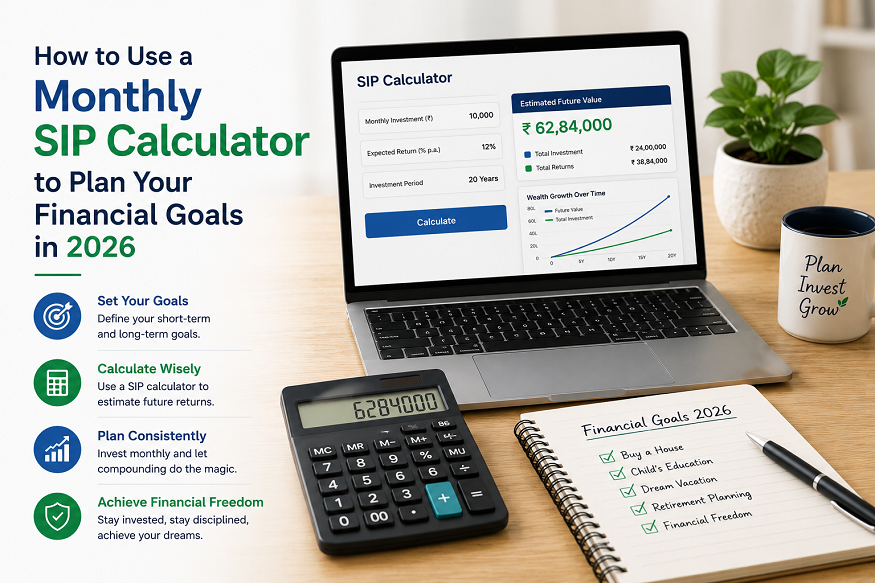
A monthly SIP calculator is, at its core, a what-if machine. You punch in three things: how much you can invest every month, for how long, and at what expected rate of return. Then it spits out a future value. Simple, right? But the magic isn’t in the simplicity. It’s in what you discover when you start playing with the numbers.
Say you decide you can invest a modest amount each month, maybe something that doesn’t hurt but still feels meaningful. The number that shows up on the other side? It’s usually enough to make someone stare at the screen for a minute.
The Inputs Matter More Than You Think
Okay, so most people just enter numbers and trust the output. But let me walk you through what each input actually means in real life, because if you get these wrong, the calculator gives you a beautiful number that has nothing to do with your reality.
Monthly investment amount. This figure should be what you can genuinely commit to every single month without fail, not the amount you wish you could invest, and definitely not a number you picked because it felt impressive. Think about your actual take-home after rent, EMIs, groceries, and those little expenses that somehow always show up uninvited.
Investment duration. Here’s where people get a bit dreamy. “Oh, I’ll invest for 30 years.” Wonderful in theory. But be honest with yourself. Are you investing in a specific goal, say, a child’s education in 15 years or retirement at 60? The duration should be tied to a real milestone in your life, not just an optimistic round number.
Expected rate of return. This parameter is the trickiest one. Equity-oriented funds have historically delivered somewhere in the range of 10 to 14 percent annually over long horizons. But the past doesn’t guarantee the future. A safe approach? Run your projection at two or three different return scenarios: a conservative estimate, a moderate one, and an optimistic one. See the range. That range is your reality corridor.
Goals First, Calculator Second
Now here’s a mindset shift that changed how I think about all of this: don’t open the calculator first. Start with the goal.
What specific goals are you aiming to save for? A home? Your kid’s college fees in 12 years? A sabbatical you’ve been quietly dreaming about? Once you know the destination and the approximate cost, the calculator works backwards for you. You enter the target corpus, the timeline, and the expected return, and it tells you the monthly amount you need to invest right now to get there.
This approach provides a distinct sense of purpose compared to simply saving money and hoping it accumulates. It’s purposeful. It’s concrete. And honestly? It’s motivating in a way that vague savings goals never are.
The Compounding Reality Check
Compounding is that concept everyone talks about, but almost nobody genuinely internalizes it until they see it in a graph. Let’s talk about it plainly.
It almost looks like it’s crawling. And if you only look at it during this phase, you might get discouraged and pull out. Huge mistake. Because compounding is a back-loaded phenomenon. The real magic occurs in the later years. The money you invested in year one isn’t just sitting there. It has been generating compounded returns over time. By the age of fifteen or twenty, the growth curve bends upward in a way that feels almost unreasonable.
This is why starting early matters more than starting with a lot. A smaller amount begun ten years sooner will almost always outperform a larger amount started later. The calculator will show you the difference if you run both scenarios side by side. Do that. It’s eye-opening.
Common Mistakes People Make When Using These Tools
Alright, let me be a little blunt here, because I’ve seen this happen enough times to consider it a pattern.
People pick an expected return that’s wildly optimistic, like 18 or 20 percent, because they’ve heard stories about that one fund that did exceptionally well for a couple of years. Those are outliers, not norms. Build your plan on realistic expectations and treat anything above that as a pleasant surprise, not a baseline.
Another thing: people forget to account for inflation. If your goal is to have a certain amount in fifteen years, remember that the purchasing power of that amount in the future is not the same as it is today. A car that costs ten lakhs now might cost considerably more in 2040. Factor that in when you decide on your target corpus.
Lastly, the most common scenario is that people calculate their potential returns, feel good about the numbers, but never actually start the investment. The calculator is a planning tool. The plan only works when you execute it.
Revisiting Your Plan as Life Changes
You’re not the same person you’ll be in five years. Your income will hopefully grow. Your expenses will shift. Maybe you get a promotion. Maybe you have a child. Maybe your goals change entirely because life, as we know, has a wonderful way of surprising us.
Read More : Why Loan Prepayment Conditions Matter More in Long-Tenure Vehicle Loans
This is why it makes sense to revisit your investment plan at least once a year. Not to obsessively tinker, but just to check in. Has your monthly capacity changed? Has your goal timeline shifted? Do the numbers still make sense? Plugging updated figures into a monthly SIP calculator every year keeps your plan honest and your expectations grounded.
Putting It All Together in 2026
So where does this leave us? If you’ve been hesitant to commit to your financial goals this year, consider the monthly SIP calculator as a reflection of your current habits and the potential outcomes of different choices. It reflects what your current habits will lead to, and it shows you what different choices could lead to instead.
Start with a goal you actually care about. Plug in honest numbers. Look at the range of outcomes. Then start. The most important step isn’t getting the inputs perfect; it’s beginning. Markets reward patience and consistency far more than they reward brilliance or timing. You don’t need to be a financial expert to build real wealth. You just need a plan, a little discipline, and yes, the clarity that a good calculator can give you. So open one up today. The future version of you will be glad you did.